
Concrete Calculator
The most popular online concrete calculator to quickly estimate the volume and number of bags you need for your project.
Slabs, Square Footings, or Walls Calculator
Length × width × thickness, for slabs, square footings, patios and walls.
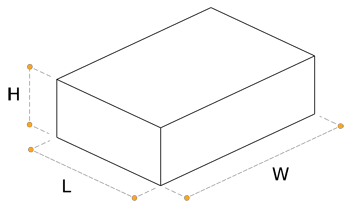
Formula
Volume = Length × Width × Thickness × Quantity × (1 + Waste%)
Hole, Column, or Round Footings Calculator
Volume of a round column, post hole, pier or round footing.
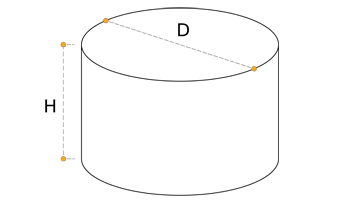
Formula
Volume = π × (Diameter ÷ 2)² × Depth × Quantity × (1 + Waste%)
Circular Slab or Tube Calculator
A hollow cylinder: pipe, culvert, ring or tube form.
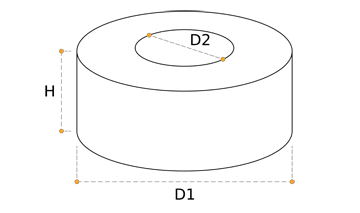
Formula
Volume = π × (R₁² − R₂²) × Length × Quantity × (1 + Waste%)
Curb and Gutter Barrier Calculator
Curb plus gutter flag, from the cross-section and the run length.
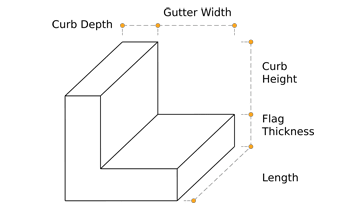
Formula
Volume = (Curb Depth × Curb Height + (Curb Depth + Gutter Width) × Flag Thickness) × Length × Qty × (1 + Waste%)
Concrete Stairs Calculator
Solid concrete steps with a platform.
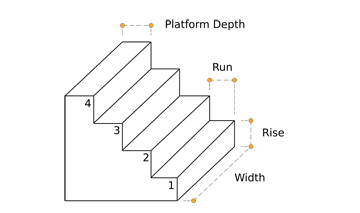
Formula
Volume = Width × Rise × (Platform Depth × Steps + Run × Steps × (Steps − 1) ÷ 2) × (1 + Waste%)
Results
Example: a 10 ft × 10 ft slab, 4 in thick. Change any value and press Calculate.
No waste allowance added. 5–10% is the usual advice for real pours.
Weight here uses 2,130 kg/m³ (133 lb/ft³) and bags are counted from that weight. The weight calculator and the single-shape calculators use the 150 lb/ft³ design value, so their weights run a little higher.
Show the math
• Length: 10 foot = 3.0480 m
• Width: 10 foot = 3.0480 m
• Thickness: 4 inch = 0.1016 m
• Quantity: 1
• Waste Factor: 0%
Calculation:
Base Volume = Length × Width × Thickness × Quantity
Base Volume = 3.0480 × 3.0480 × 0.1016 × 1
Base Volume = 0.9439 m³
Final Volume = Base Volume × (1 + 0%)
Final Volume = 0.9439 × 1.000
Final Volume = 0.9439 m³
Plan the rest of the pour
Calculation history
No calculations yet.
Popular concrete calculators
View all calculators- Slab calculatorLength × width × thickness to yards and bags.
- Footing calculatorStrip or spread footings in yards and bags.
- Column calculatorRound or square columns, piers and footings.
- Wall calculatorPoured walls with door and window openings.
- Stairs calculatorSolid concrete steps with an optional landing.
- Curb and gutter calculatorCurb, gutter and flag from the cross-section.
- Driveway calculatorDriveway yards, thickness and cost range.
- Patio calculatorPatio slabs sized to your furniture.
- Bag calculatorHow many 40, 50, 60 and 80 lb bags.
- Yards calculatorSquare feet × thickness = cubic yards.
- Weight calculatorPounds, tons and kilograms for any volume.
- Cost calculatorCompare a truck with bags using your prices.
How much concrete do I need?
Concrete is sold by volume, so the job always comes down to three measurements: length, width and depth. Multiply them in the same unit and you have the volume. In the US the order unit is the cubic yard, which is 27 cubic feet, so the last step is to divide the cubic feet by 27.
The one place people go wrong is thickness. Slab thickness is quoted in inches, but length and width are in feet. Convert it exactly: 4 in is 4 ÷ 12 = 0.3333… ft. Rounding it to 0.33 before multiplying throws away about one percent of the volume, which is the difference between ordering enough and standing next to a half-filled form.
Example 1: a 10 × 10 ft slab, 4 in thick
10 × 10 × (4 ÷ 12) = 33.33 ft³, and 33.33 ÷ 27 = 1.23 yd³. Add 10% for uneven subgrade and spillage and you order about 1.36 yd³. In bags, that is 62 bags of 80 lb mix, which is why a slab this size is a bagged job for a weekend and a ready-mix call for anything bigger.
Example 2: a 24 × 24 ft slab, 4 in thick
24 × 24 × (4 ÷ 12) = 192.00 ft³ = 7.11 yd³. With a 5% allowance the order is 201.60 ft³, or 7.47 yd³. That is 336 bags of 80 lb mix; nobody hand-mixes that, so this is a truck. Ask the plant for a short-load fee before you commit, because orders under about 7 yd³ often carry one.
The calculator above does exactly this arithmetic and shows every step under Show the math, so you can check it against a quote.
| Thickness | Area per yd³ | Metric |
|---|---|---|
| 3 in | 108 ft² | 10 m² |
| 4 in | 81 ft² | 7.5 m² |
| 5 in | 64.8 ft² | 6 m² |
| 6 in | 54 ft² | 5 m² |
Exact: 27 ft³ ÷ thickness in feet. Waste not included.
Concrete guides
All guides- How much concrete do I needThe formula, units, waste and worked examples.
- Bags of concrete per yardBag counts for 40, 50, 60 and 80 lb mix.
- Slab thickness guideWhat 3, 4, 5 and 6 inches are used for.
- Concrete cost per yardReady-mix price ranges and what moves them.
- Bagged vs ready-mixBreak-even volume, labor and quality compared.
- How to order ready-mixWhat to tell the plant before the truck rolls.
Cost snapshot
Ready-mix usually lands between $125 and $195 per cubic yard delivered, before any short-load fee, which commonly runs $50–$200 on orders under about 7 yd³. An 80 lb bag is roughly $5.5–$8. Prices vary by region and change often, so treat these as ranges and get a local quote. Last verified 2026-10-04. See concrete cost per yard or run the cost calculator with your own prices.
Quick charts
Skip the arithmetic for common sizes. The slab yardage chart lists cubic yards for slabs from 10 × 10 to 40 × 40 ft at four thicknesses, and the fractional yards chart turns ¼, ½ and ¾ yard into bag counts. There are also pages for the sizes people search most, such as a 12 × 16 slab and a 24 × 24 slab.
Concrete calculator FAQ
How do I calculate how much concrete I need?
Multiply length × width × thickness in feet to get cubic feet, then divide by 27 to get cubic yards. Convert inches to feet by dividing by 12. Add 5–10% for waste. A 10 × 10 ft slab at 4 in is 33.33 ft³, or 1.23 yd³.
How many 80 lb bags of concrete make a cubic yard?
About 45. One 80 lb bag yields roughly 0.60 ft³ and a cubic yard is 27 ft³, so 27 ÷ 0.60 = 45. Smaller bags yield less: 60 lb bags make 60 per yard, 50 lb bags 72 and 40 lb bags 90. Always check the yield printed on your bag.
How much does a cubic yard of concrete weigh?
Normal-weight concrete is commonly taken as 150 lb per cubic foot, which makes a cubic yard about 4,050 lb, a little over 2 tons. Real mixes range from about 140 to 150 lb/ft³. The calculator on this page uses 2,130 kg/m³, so its weights read slightly lower than the weight calculator.
Should I add extra for waste?
Yes. Most guidance is 5–10% for a clean, well-prepared pour. Go higher when the subgrade is uneven, the forms may bulge or the pour is hard to reach. Running short mid-pour is far more costly than a little leftover concrete.
What is the difference between cement, concrete and mortar?
Cement is the powder binder. Concrete is cement mixed with sand, gravel and water. Mortar is cement, sand and water with no gravel, used to bond bricks and blocks. Calling a driveway a cement driveway is common, but the material is concrete.
Can I use metric units?
Yes. Every length field has a unit selector for feet, inches, yards, meters or centimeters, and the results show cubic feet, cubic yards and cubic meters together. The single-shape calculators also remember a US or metric preference on your device.
How accurate is the calculator?
The arithmetic is exact. The result is only as good as the measurements, the true thickness of your subgrade and the waste allowance you choose. Treat it as a planning and ordering aid and confirm quantities with your supplier or engineer for structural work.
Does my calculation history leave my device?
No. The last five calculations are saved in your browser only, under the key concreteHistory, and you can delete any of them. We do not receive your measurements.
Get a number you can order from
Pick the shape closest to your job, add your waste allowance, then use the Pour List to combine slab, footings and steps into a single order. Every figure comes with the math behind it and the sources are listed on the methodology page.
Choose a calculator Open my Pour List
Estimate only. Results depend on the numbers you enter, ground conditions and your supplier. For structural work consult a licensed engineer and follow local codes. Brand names such as Quikrete and Sakrete are used only to cite published product data. This site is not affiliated with any brand.